 P3C Technology and Solutions
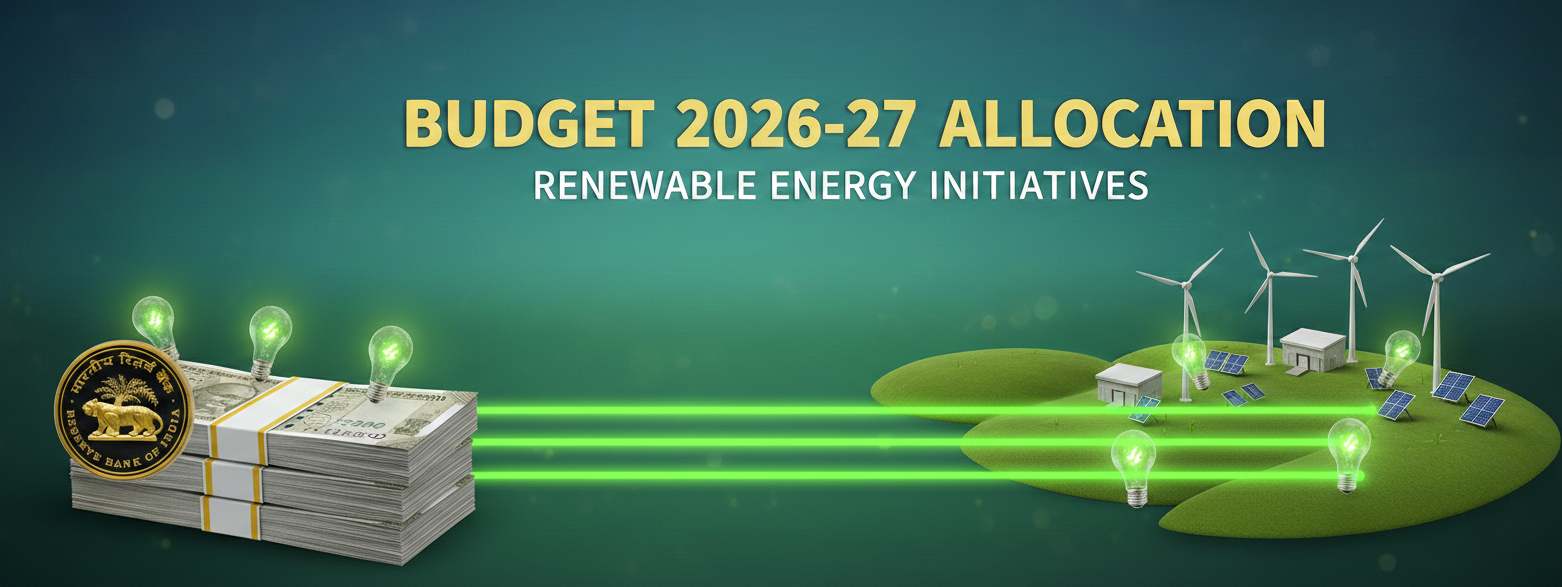
How ₹32,915 Crore is Reshaping India's Clean Energy Landscape
When Finance Minister Nirmala Sitharaman presented the Union Budget 2026-27 on February 1st, she didn't just announce numbers she unveiled a vision. A vision where every rooftop becomes a mini power plant, where farmers pump water using sunlight instead of diesel and where India stands as a global leader in the clean energy revolution. The budget's renewable energy allocations aren't merely financial figures; they represent a fundamental shift in how India imagines its energy future.
The headline figure ₹32,915 crore allocated to the Ministry of New and Renewable Energy (MNRE) marks a striking 30.1% increase from the previous year. But beneath this number lies a strategic blueprint that touches every corner of India's energy ecosystem, from urban households to rural farmlands, from research laboratories to manufacturing hubs.
Understanding the Numbers: Where Every Rupee Goes
To truly appreciate the scale of this commitment, we need to break down the allocations across India's renewable energy portfolio:
| Program/Sector | Allocation (₹ Crore) |
| Total MNRE Budget | ₹32,915 |
| Solar Energy Sector | ₹30,539 |
| PM Surya Ghar Muft Bijli Yojana | ₹22,000 |
| PM-KUSUM (Agricultural Solar) | ₹5,000 |
| Solar Power (Grid-Scale) | ₹1,775 |
| Green Energy Corridors | ₹600 |
| National Green Hydrogen Mission | ₹600 |
One number stands out immediately: solar energy commands over 92% of the MNRE's scheme spending with ₹30,539 crore. This isn't just a budget line it's a declaration that solar is the centerpiece of India's renewable future.
The Solar Revolution: From Consumers to Prosumers
The PM Surya Ghar Muft Bijli Yojana, with its massive ₹22,000 crore allocation, represents the single largest renewable energy program in India's history. The vision here is transformative: turning ordinary citizens from passive electricity consumers into active producers or 'prosumers' as the industry calls them.
Imagine a typical middle-class household in Delhi, Mumbai or Bangalore. Today, they receive an electricity bill each month. Tomorrow, with rooftop solar panels subsidized under this scheme, they could be generating their own power, slashing their bills and even feeding surplus electricity back into the grid. This isn't science fiction it's the immediate future being funded by this budget.
The impact extends beyond individual savings. When millions of rooftops become power generators, we're looking at a fundamental decentralization of India's energy infrastructure. This reduces transmission losses, enhances grid resilience and creates a more democratic energy system where power quite literally rests with the people.
Empowering Farmers: The Agricultural Solar Push
While urban rooftops get attention, the PM-KUSUM scheme's ₹5,000 crore allocation targets a different but equally crucial demographic: India's farmers. The name itself Pradhan Mantri Kisan Urja Suraksha evam Utthaan Mahabhiyan—speaks to its ambition of energy security and upliftment for agricultural communities.
For decades, Indian farmers have battled two interconnected challenges: unreliable power supply and escalating diesel costs for irrigation pumps. PM-KUSUM attacks both problems simultaneously. By subsidizing solar pumps and the solarization of existing grid-connected pumps, the scheme promises farmers energy independence, lower operating costs, and protection from volatile fuel prices.
The 92% increase in PM-KUSUM's allocation from the previous year signals serious intent. This isn't incremental improvementit's a recognition that agricultural transformation and energy transformation must go hand in hand if India is to achieve true rural prosperity.
The Opportunity Cascade: Jobs, Manufacturing and Innovation
Budget allocations don't exist in isolation—they trigger cascading effects across the economy. The 2026-27 renewable energy budget is expected to catalyze opportunities across multiple dimensions:
Manufacturing Renaissance
The budget includes strategic duty exemptions that could reshape India's solar manufacturing sector. The elimination of Basic Customs Duty on sodium antimonate (used in solar glass manufacturing) and capital goods for lithium-ion cell production addresses a critical bottleneck: the high cost of domestic production.
With ₹40,000 crore earmarked for electronics manufacturing including solar inverters, charge controllers and tracking sensors India is positioning itself not just as a consumer of solar technology but as a global supplier. This could transform the trade deficit into a trade surplus as Indian manufacturers begin exporting to markets worldwide.
Employment Generation
Every megawatt of solar capacity installed creates jobs from panel manufacturing to installation, from maintenance to grid integration. Industry estimates suggest that the solar sector could generate over 330,000 jobs across the value chain in the coming years. These aren't just high-skilled engineering roles; they include technicians, installers, sales personnel, and support staff, creating opportunities across skill levels.
Innovation Ecosystem
The doubling of the Green Hydrogen Mission's budget to ₹600 crore, while modest compared to solar, signals support for next-generation technologies. Green hydrogen produced using renewable electricity could be the key to decarbonizing heavy industries like steel and cement. By investing early, India positions itself at the forefront of an emerging global market.
Building the Backbone: Grid Infrastructure and Energy Storage
Renewable energy's Achilles' heel has always been intermittency the sun doesn't always shine and the wind doesn't always blow. The budget addresses this through strategic investments in grid infrastructure and energy storage.
The ₹600 crore allocation for Green Energy Corridors focuses on building high-capacity transmission lines that can move solar power from generation hubs (like Rajasthan's deserts) to consumption centers (like Delhi or Mumbai). Meanwhile, customs duty exemptions for lithium-ion cells used in Battery Energy Storage Systems (BESS) are designed to make grid-scale batteries more affordable.
These investments aren't glamorous—they don't produce eye-catching headlines—but they're foundational. Without robust transmission and storage, all the solar panels in the world won't deliver reliable, 24/7 electricity.
Beyond Renewables: The Carbon Capture Bet
Not all emissions can be eliminated through renewable energy alone. Industries like cement, steel and chemicals will require decades to transition fully. This is where the budget's ₹20,000 crore, five-year allocation for Carbon Capture, Utilization and Storage (CCUS) comes in.
CCUS technology captures carbon dioxide emissions at source, preventing them from entering the atmosphere. While controversial among some environmentalists who see it as a crutch that delays fossil fuel phase-out, pragmatists argue it's essential for hard-to-abate sectors. The budget's CCUS allocation represents a hedging strategy pursuing renewables aggressively while ensuring heavy industry can decarbonize without economic collapse.
The 500 GW Target: Ambition Meets Execution
All these investments ladder up to India's headline commitment: achieving 500 gigawatts (GW) of non-fossil fuel electricity capacity by 2030. As of early 2026, India has approximately 200 GW of renewable capacity. Reaching 500 GW means adding 300 GW in just four years an unprecedented rate of installation.
Is it achievable? The budget suggests the government believes so. The ₹32,915 crore MNRE allocation, combined with the overall ₹2.99 lakh crore power sector budget, provides the financial muscle. But money alone won't suffice. Success will require:
- Streamlined Approvals: Land acquisition and environmental clearances must accelerate without compromising oversight.
- Manufacturing Scale-Up: Domestic production must ramp up to reduce import dependence and control costs.
- Grid Modernization: The transmission network must expand to handle massive influxes of renewable power.
- Financing Innovation: Banks and financial institutions need confidence in renewable projects' bankability.
- Consumer Participation: Households and businesses must adopt rooftop solar at unprecedented rates.
The Union Budget 2026-27 renewable energy allocations represent more than fiscal policy they embody a national aspiration. They tell a story about India's determination to balance economic growth with environmental responsibility, to create prosperity without compromising the planet and to lead rather than follow in the global clean energy transition.
When future historians look back at India's energy journey, February 1, 2026, may be remembered as an inflection point the moment when renewable energy moved from the periphery to the center of national strategy. The ₹32,915 crore MNRE allocation isn't just money; it's an investment in a future where energy is clean, abundant and democratically distributed.
Success will require more than government spending. It demands innovation from entrepreneurs, cooperation from states, efficiency from utilities and adoption by citizens. But if these pieces align, India's solar revolution could illuminate not just its own path forward, but serve as a beacon for developing nations worldwide.
The budget has set the stage. Now begins the hard work of execution. And in that execution lies the difference between aspiration and achievement, between targets and reality, between a greener India and a merely talked-about one.
The sun is rising on India's renewable future. The question is: will we harness its full potential?